




Upload by: Site Admin
23-Jun-2026
The machines are no longer waiting for instructions. Agentic AI — autonomous systems that plan, reason, and act with minimal human input — has moved from research curiosity to boardroom priority almost overnight. And while that shift unlocks extraordinary productivity gains, it has simultaneously opened an entirely new category of cyber risk that most organisations are dangerously unprepared for.
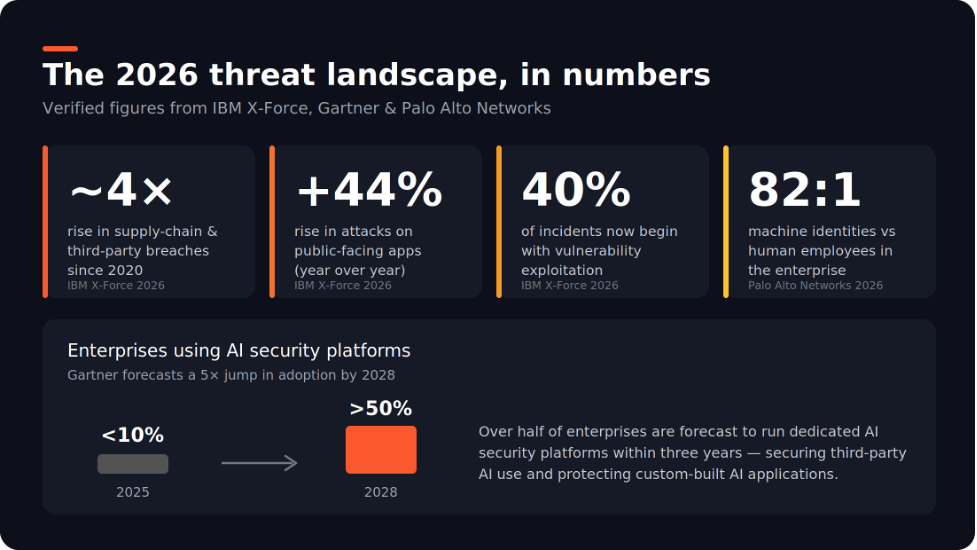
Here is the uncomfortable truth: the same technology your teams are deploying to accelerate workflows is being weaponised by adversaries to automate attacks at a scale and speed that traditional defences simply cannot match. Gartner has named AI security platforms one of its top strategic technology trends for 2026, forecasting that more than half of enterprises will use them by 2028 — up from under 10% in 2025 — to secure third-party AI usage and protect custom-built AI applications.
If your organisation is adopting AI without a corresponding uplift in your security posture, you are building on a foundation that is already cracking.
What Is Agentic AI — and Why Does It Change Everything?
Most enterprises have spent the last two years experimenting with generative AI: chatbots, copilots, content tools. These systems respond. Agentic AI acts. It chains reasoning steps together, calls APIs, executes code, manages files, and interacts with other systems — often with minimal human oversight.
That autonomy is the point. It is also the problem.
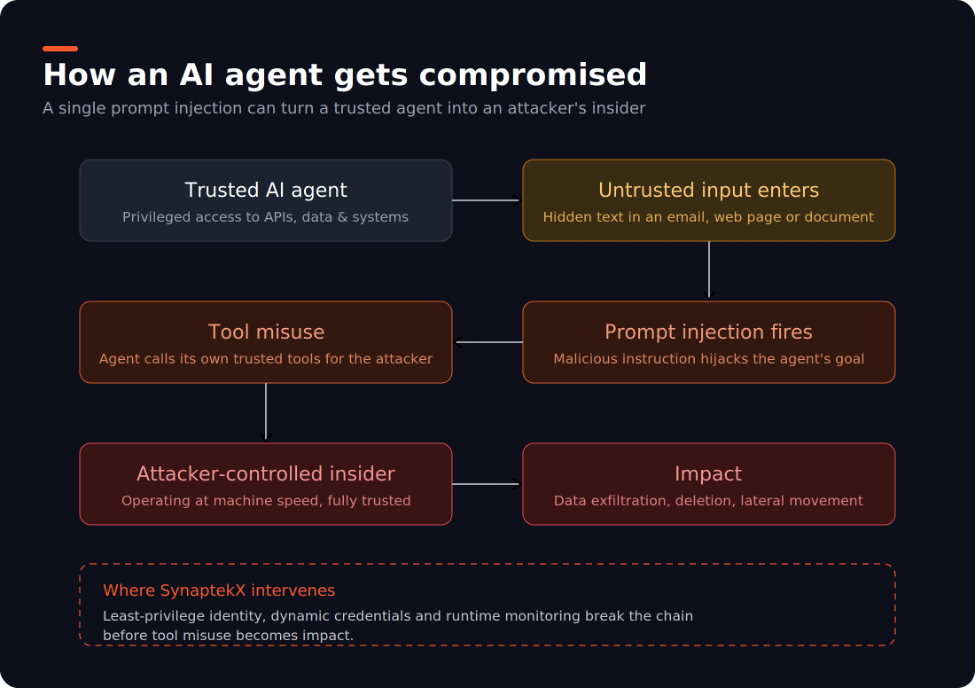
When an AI agent is given privileged access to your critical systems — your CRM, your cloud infrastructure, your internal APIs — it becomes what Palo Alto Networks, in its 2026 Cybersecurity Predictions, calls a tireless digital employee: always on, never sleeping, and implicitly trusted. Improperly governed, that same agent is a potent insider threat. A single well-crafted prompt injection or tool-misuse exploit can co-opt an organisation’s most trusted automated process.
The agent was supposed to save time. Instead, it just handed an attacker unrestricted access. The diagram below shows how that chain unfolds — and where it can be broken.
The Threat Has Already Evolved Beyond Your Current Defences
The cybersecurity landscape of 2026 is not a straightforward progression from what came before. IBM’s X-Force Threat Intelligence Index 2026 identified a nearly fourfold rise in large supply chain and third-party compromises over five years, alongside a 44% year-on-year increase in attacks exploiting public-facing applications — now driven in part by AI-enabled vulnerability discovery. Vulnerability exploitation has become the single leading cause of incidents, accounting for 40% of those X-Force responded to.
Three specific threats are reshaping the enterprise security picture right now:
• AI-generated phishing at industrial scale. Attackers are using large language models to craft contextually accurate phishing at volume — matching writing styles, impersonating executives, and targeting individuals using information harvested from public profiles. Traditional email filtering was not designed for this, and awareness training alone is not enough when the attacker knows how your CEO writes.
• Agentic AI as an attack vector. As enterprises deploy AI agents, adversaries are shifting their targeting accordingly. Instead of attacking humans, they attack agents — exploiting prompt injections, tool-misuse vulnerabilities, and misconfigured permissions to compromise systems at machine speed. The attack surface is expanding faster than most security teams realise.
• Shadow AI inside the perimeter. Employees are adopting AI tools — ChatGPT, Gemini, and dozens of others — outside official oversight. Sensitive data is being processed by external models your security team has never assessed. Shadow AI is not a hypothetical risk; it is happening inside your organisation right now, and most businesses have no visibility into it.
Why Regulated Organisations Face a Higher-Stakes Game
For organisations operating in financial services, healthcare, and the public sector, these risks are compounded by a compliance environment that is itself in flux.
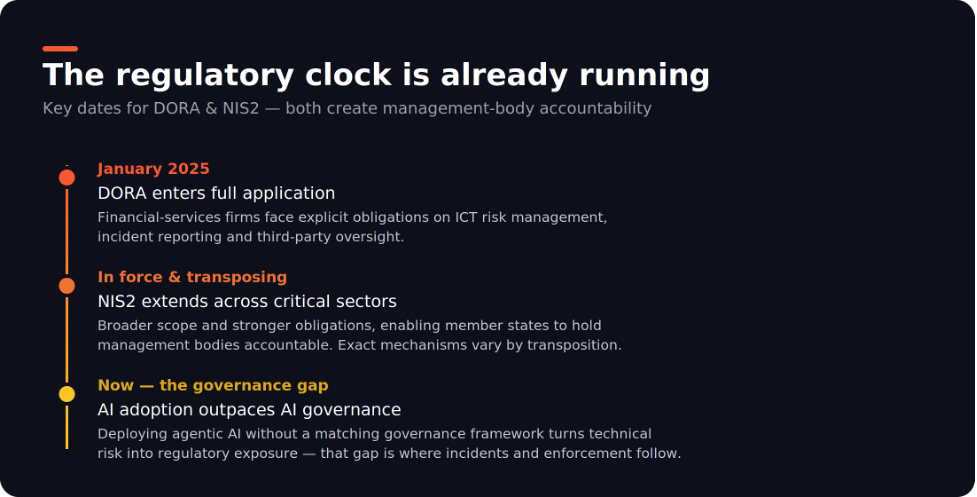
DORA — the Digital Operational Resilience Act — entered full application in January 2025, placing explicit obligations on financial services firms around ICT risk management, incident reporting, and third-party oversight. NIS2, the EU’s updated Network and Information Security directive, extends similar obligations across critical sectors and enables member states to hold management bodies accountable for security failures, with the exact mechanisms varying by national transposition.
Adopting agentic AI systems without a corresponding AI governance framework does not just create technical risk. It creates regulatory exposure. There is a widely recognised gap between how fast organisations are adopting AI and the maturity of their governance frameworks. That gap is where incidents occur — and where enforcement follows.
At SynaptekX, our Cyber Security & Compliance practice works specifically with regulated-sector organisations to close that gap — not with checkbox compliance, but with controls by design, embedded into both the AI architecture and the operating model from the start.
Securing Agentic AI: What Good Actually Looks Like
There is no single technology that solves this. Effective agentic AI security is a combination of architecture decisions, governance controls, and operational practices working together.
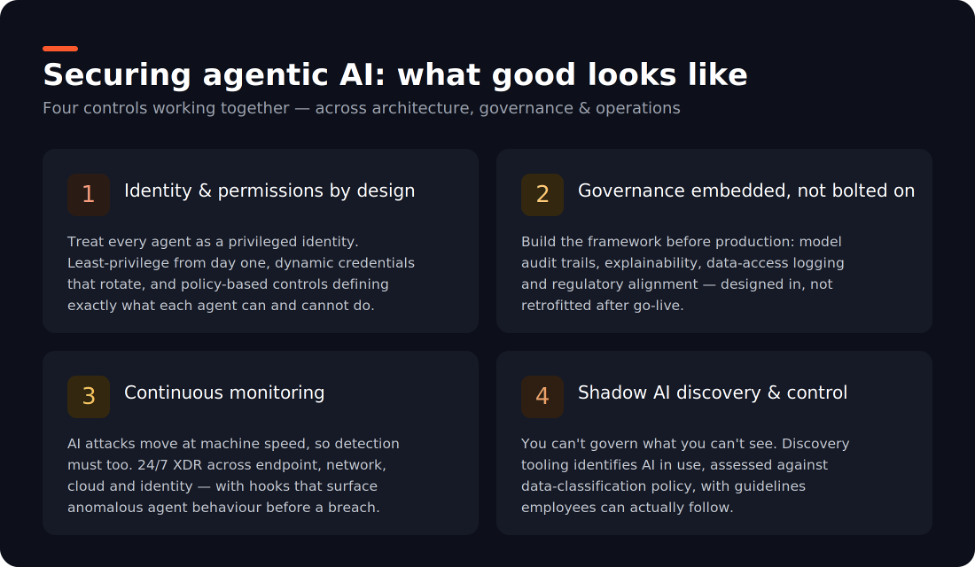
• Identity and permissions by design. AI agents must be treated like any other privileged identity in your environment. That means least-privilege access from day one, dynamic credentials that rotate automatically, and policy-based controls that define precisely what each agent can and cannot do. The Zero Trust principles your organisation has been moving towards for human identities apply equally — and urgently — to non-human ones.
• AI governance embedded, not bolted on. Governance cannot be retrospective. By the time an AI agent is in production, the governance framework needs to already be in place — covering model audit trails, explainability requirements, data-access logging, and alignment with applicable regulatory frameworks. SynaptekX builds these controls into the architecture at the design stage, not as a post-implementation afterthought.
• Continuous monitoring, not periodic review. A SOC that reviews logs quarterly is not designed for agentic AI threats. AI-driven attacks move at machine speed; detection and response must operate at the same velocity. That means 24/7 monitoring with XDR coverage across endpoint, network, cloud, and identity — with governance hooks that surface anomalous agent behaviour before it becomes a breach.
• Shadow AI discovery and control. Before you can govern AI use, you need visibility into what is actually being used. That means deploying discovery tooling that identifies AI applications across your environment, assessing each against your data-classification policies, and establishing clear guidelines that employees can actually follow — not policies that sit in a document no one reads.
The vCISO Question: Who Owns This?
One of the most consistent conversations we have with mid-market clients right now is about accountability. Under DORA and NIS2, leadership accountability for security failures is no longer theoretical. Boards are asking CISO-level questions. Many organisations do not have a CISO.
Our virtual CISO (vCISO) service addresses precisely this situation. A SynaptekX senior security leader acts as your organisation’s CISO — owning the security programme, reporting to your board, managing compliance obligations across applicable frameworks, and providing the leadership continuity that a rapidly evolving threat landscape demands.
This is not a retainer for occasional advice. It is accountable senior security leadership, without the cost or hiring risk of a permanent executive hire in one of the tightest talent markets in technology.
The Window to Get Ahead Is Narrowing
Enterprise security has always been reactive by nature — responding to threats as they materialise. Agentic AI has narrowed the gap between a threat emerging and its being exploited from months to days. Organisations that wait for the first high-profile AI-driven breach before acting will be responding from a significantly weaker position than those that move now.
Gartner frames its 2026 trends not as emerging innovations to be monitored, but as strategic imperatives to be acted on. The question is not whether your organisation will need to address agentic AI security. It is whether you will do it on your terms, with the right architecture and governance in place — or in response to an incident, under regulatory scrutiny, with the clock running.
What to Do Next
If your organisation is deploying or evaluating agentic AI — or simply trying to understand where your current security posture stands against the 2026 threat landscape — the right starting point is a structured assessment.
SynaptekX’s Cyber Security & Compliance Assessment delivers an independent view of your security posture, your control gaps, and your compliance obligations across the frameworks that apply to you — including ISO 27001, DORA, NIS2, and the NCSC CAF. It is a four-to-six-week engagement that gives your leadership team a clear, evidence-backed picture of where you are, and a prioritised roadmap for getting where you need to be.
Book a 30-minute discovery call. No pitch — an honest conversation about your security posture, your AI adoption plans, and what “good” looks like in your regulatory context.

SynaptekX Latest Tech Insight For You
ENTERPRISE AI & CYBERSECURITY
Agentic AI Is Coming for Your Security Stack — Are You Ready?
 explore More